
Local SEO
Why Your Competitors Outrank You on Google (And How to Fix It Free)
Five high-leverage actions to improve local visibility across Google Search, Google Maps, and AI-powered search — without spending a dollar on ads.
12 min readUpdated 2026-08-23
Start here: what you can and can't control
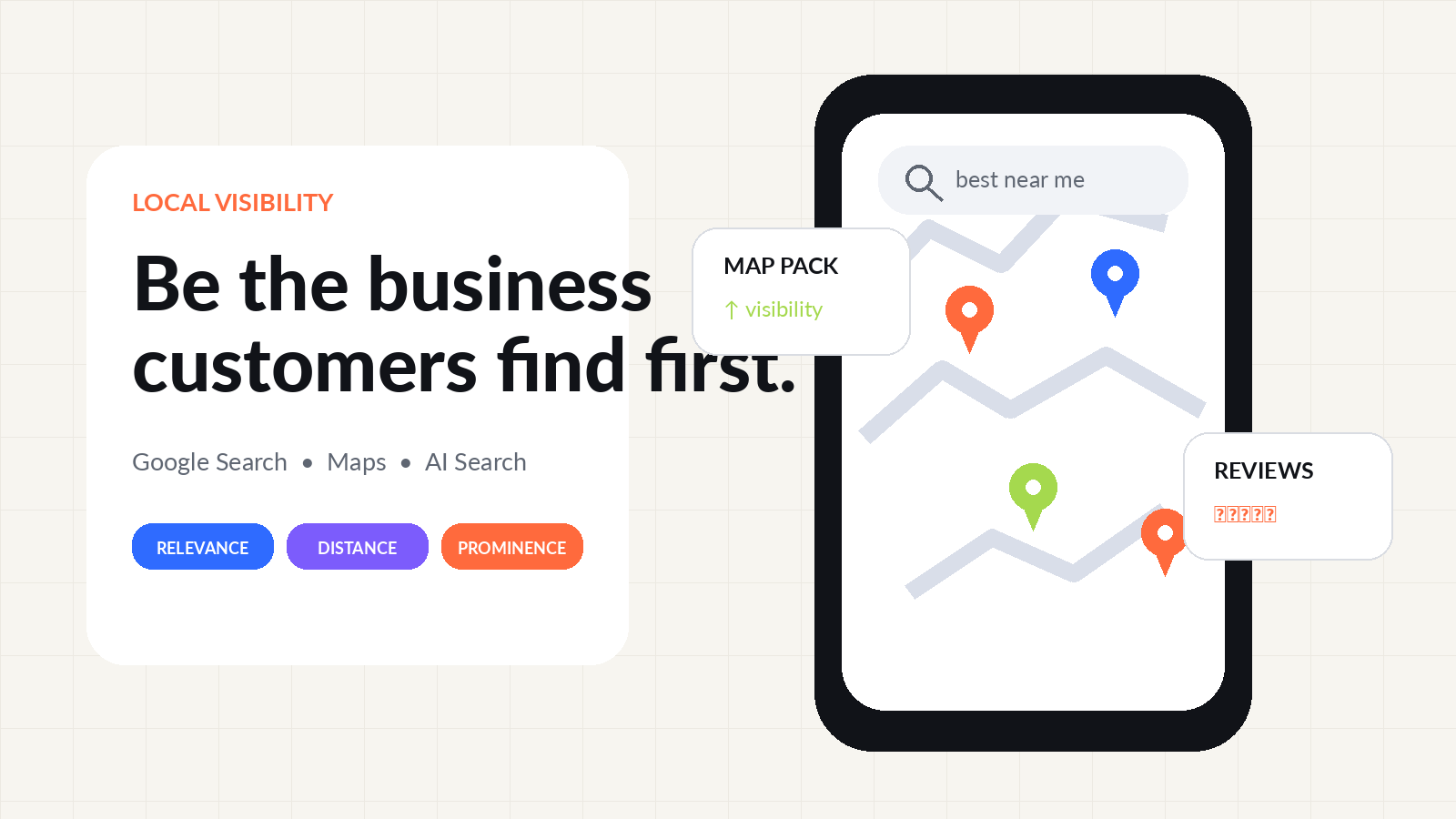
If your business doesn't show up when local customers search, you're losing opportunities to competitors who are simply easier to find. The answer isn't automatically to spend more on ads. Google says local results are primarily influenced by relevance, distance, and prominence. You can meaningfully improve relevance and prominence. You cannot change where the customer is standing. Nobody can guarantee a #1 local position — so instead of chasing tricks, make your business easier for search engines and customers to understand, trust, and choose.
- Your business information — accurate and consistent everywhere
- Your website — clear pages for the services you actually sell
- Your Google Business Profile — treated like a storefront
- Your content — real answers to real customer questions
- Your reviews — a consistent, compliant request system
#5 Fix your business info everywhere
Search engines don't look at your business in isolation. They encounter information about you on your website, Google Business Profile, Apple Maps, directories, review platforms, and social profiles. Write down one source of truth — business name, customer-facing address or service area, primary phone number, website URL, and regular hours — then compare it against every place your business appears and fix what's outdated. Claim Apple Business Connect too, since it controls how you appear across Maps and Siri.
- Google Business Profile and Apple Business Connect
- Your website contact page and footer
- Facebook, Instagram, Yelp, and Bing business information
- Industry directories, chamber and association profiles
- Old listings from previous addresses or phone numbers
Action step: create one internal document with your official business information. Every new listing gets created from that document — no guessing, no old phone number, no accidental second address.
Get the 10-page guide as a PDF
The full checklist version of this article — business info audit, AI-search content structure, website fixes, Google Business Profile pass, and the review system — in one printable file you can work through with your team.
Download the free guide (PDF)#4 Structure your content for AI search
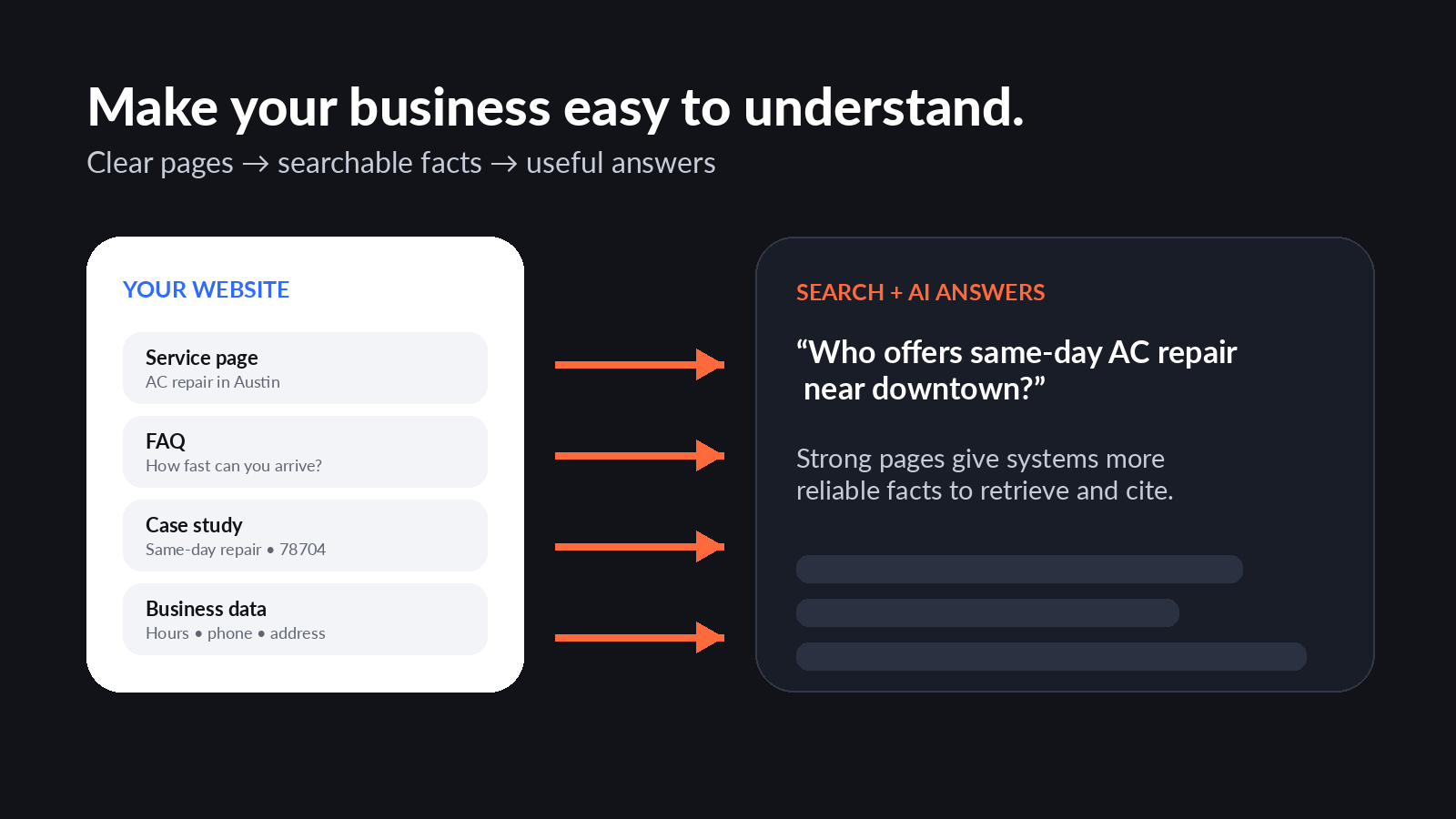
Customers no longer only type "plumber Austin TX." They ask questions like "who can replace a water heater today near me?" Google AI Overviews, AI Mode, and ChatGPT Search answer conversational questions while pointing people toward businesses. There's no magic AI SEO trick — Google says the same foundational SEO practices apply. The opportunity is making your facts easy to retrieve: answer the questions customers actually ask, state important business facts as real page text rather than only inside graphics, publish specific case studies, and keep pages scannable. Add accurate LocalBusiness structured data that matches what's visible on the page, and make sure you aren't blocking the crawlers that power these experiences.
#3 Optimize your website for the decision, not the visitor count
Your website should make four things obvious within seconds: what you do, where you do it, why you can be trusted, and what to do next. Give each important service its own useful page instead of one generic services page. Build location pages that are genuinely local — services offered there, neighborhoods served, local project examples, real photos, area testimonials, local FAQs — not fifty near-identical pages where only the city name changes, which Google warns against. Put the conversion action above the fold on mobile, make the phone number tap-to-call, keep pages fast and stable, and link related pages together.
- One clear page per service a customer actually searches for
- Location pages with real local substance
- Call, quote, or booking action above the fold on mobile
- Compressed images, fewer scripts, no giant popups
- Internal links between services, locations, and case studies
#2 Max out your Google Business Profile
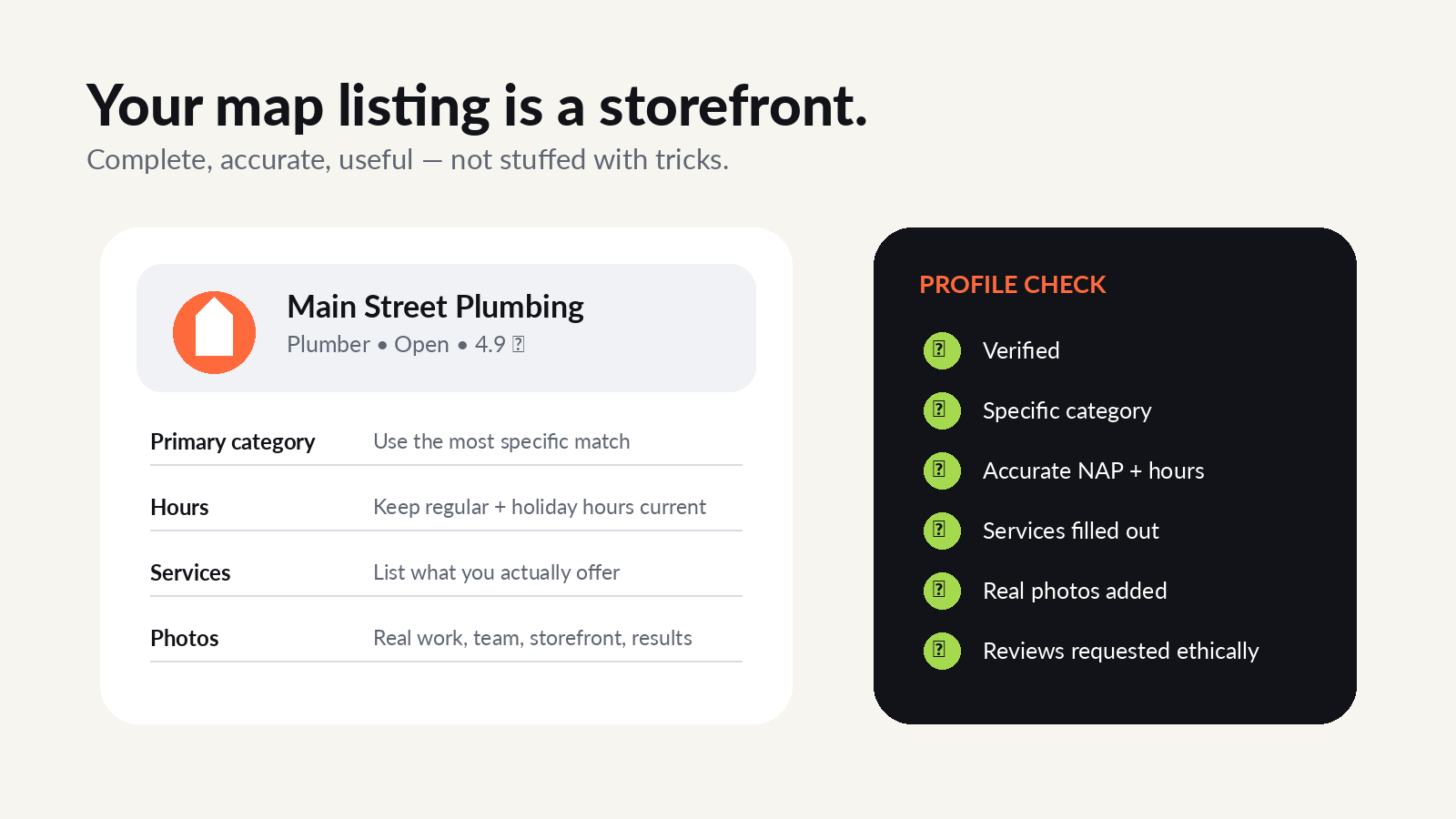
For a local business, your profile is the most valuable piece of free digital real estate you have. Choose the most specific accurate primary category — Google confirms categories can affect local ranking — then add secondary categories only for services you genuinely provide. Complete every useful field: phone, website, regular and holiday hours, service area, description, services, appointment links, attributes, and products. List services granularly so customers can tell you solve their specific problem. Add real photos of your team, vehicles, job sites, and completed work on a regular cadence. Skip the geotagged-photo myth; Google doesn't publish EXIF geotags as a ranking requirement.
#1 Build an automated review system
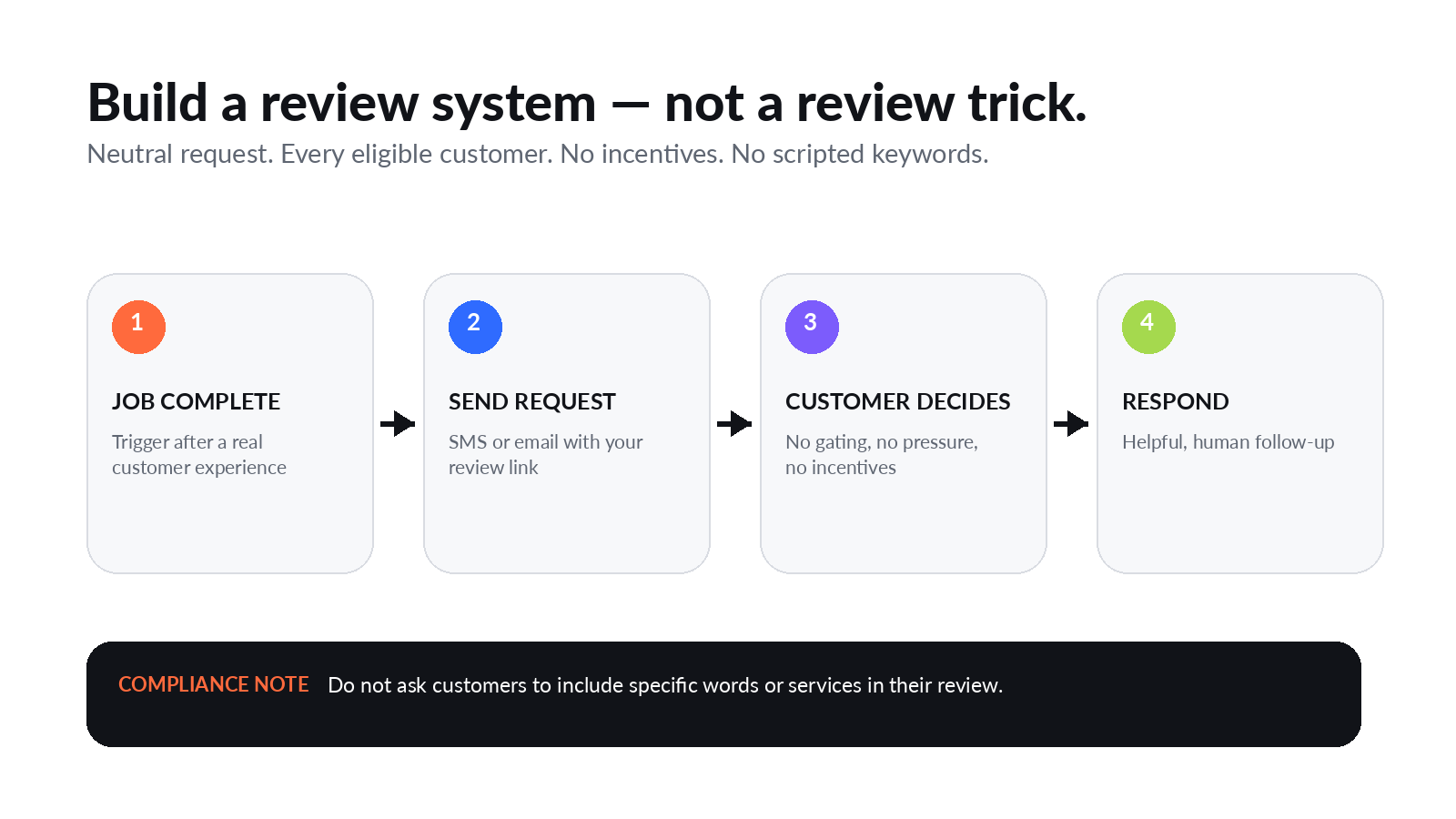
Reviews influence customers, and Google confirms review count and positive ratings can contribute to local ranking. The goal isn't a burst of five-star reviews this week — it's a consistent system that asks real customers for honest feedback after real experiences. Pick a trigger such as invoice paid or job marked complete, then send a neutral SMS or email with your direct review link so nobody has to hunt for the form. Ask every eligible customer, not just the ones you expect to be happy, and never offer incentives.
- Trigger: a completed, legitimate customer experience
- Request: neutral wording, sent automatically
- Link: straight to the review form, no searching
- Consistency: every eligible customer, not a filtered list
- Response: helpful, human replies to reviews you receive
Compliance note: Google prohibits incentives, review gating, and asking customers to include specific words or services in their review. A neutral request is both safer and more credible.
What to do with this
None of these five actions requires ad spend. They require accuracy, structure, and a repeatable habit. Work top-down: business information first, because everything else inherits it; then content and website clarity; then the profile; then the review system that compounds over time. If you'd rather see which of the five is costing you the most right now, a Locora local growth audit walks the same path a customer takes from local search to your website and names the biggest gap.